
November, 2025
Volume 1, Issue #7
Suno pitch deck breaks social media
We’ll get to my axe to grind in a moment, but first. Of course Suno was going to settle. This is one of the more expected outcomes in the whole generative AI music sector. But Kristin Robinson at Billboard got the pitch deck and reported on it. That story is paywalled, so here is a different version. However, I still go back to Kristin’s take, because she highlighted the main issue many folks have with Suno in the first place. Suno spent over $32 million to train their generative model but then identified a paltry $2,000 in “data payments.” This basically confirms what we already know. They do not pay for the use of any of the music they train on. This is one of the reasons creators are angry with Suno, whose CEO infamously said that musicians don’t enjoy making music.
So Suno settles, but I have an axe to grind
I want to feel positive about this news, but I’m not quite there yet. I am really frustrated by the way companies hide behind the language of “disruptive innovation” when what they are really doing is side-stepping rules by using unlicensed material. Plenty of generative music companies have taken the time to license training data properly. Suno didn’t. Also, this settlement only covers one major label, leaving the rest of the industry and independent artists unresolved.
I’ll choose to ethically abstain from using Suno for now. If they truly want to turn over a new leaf, maybe they should consider adopting the criteria Benji Rogers laid out on Unlimited Supply:
- A training fee, paid when an AI trains on your work.
- An attribution fee, paid proportionally to how much your work influences a specific output.
- A revenue share, when the AI output generates profit.
On a more positive note, I really appreciate the calming tone of Ed Newton Rex, who encourages us to look at the potential upside. I do value that the industry is finally moving toward licensed training practices. It gives me hope, and I’m open to changing my mind about Suno if they continue to improve their approach in meaningful ways.
My takeaways from two music conferences:
I went to the MusicTectonics conference and the Taxi Road Rally in the same week in early November. I then put together a review where I talked about the 10 things I learned. Here are three interesting ones:
- The creative economy forces artists to become full-stack managers
- Music development has adopted the rapid pace of technology
- Be prepared for the shift to acceptance of AI-generated music
Get the full take: I put together a video review here.
Google publishes SynthID-Image
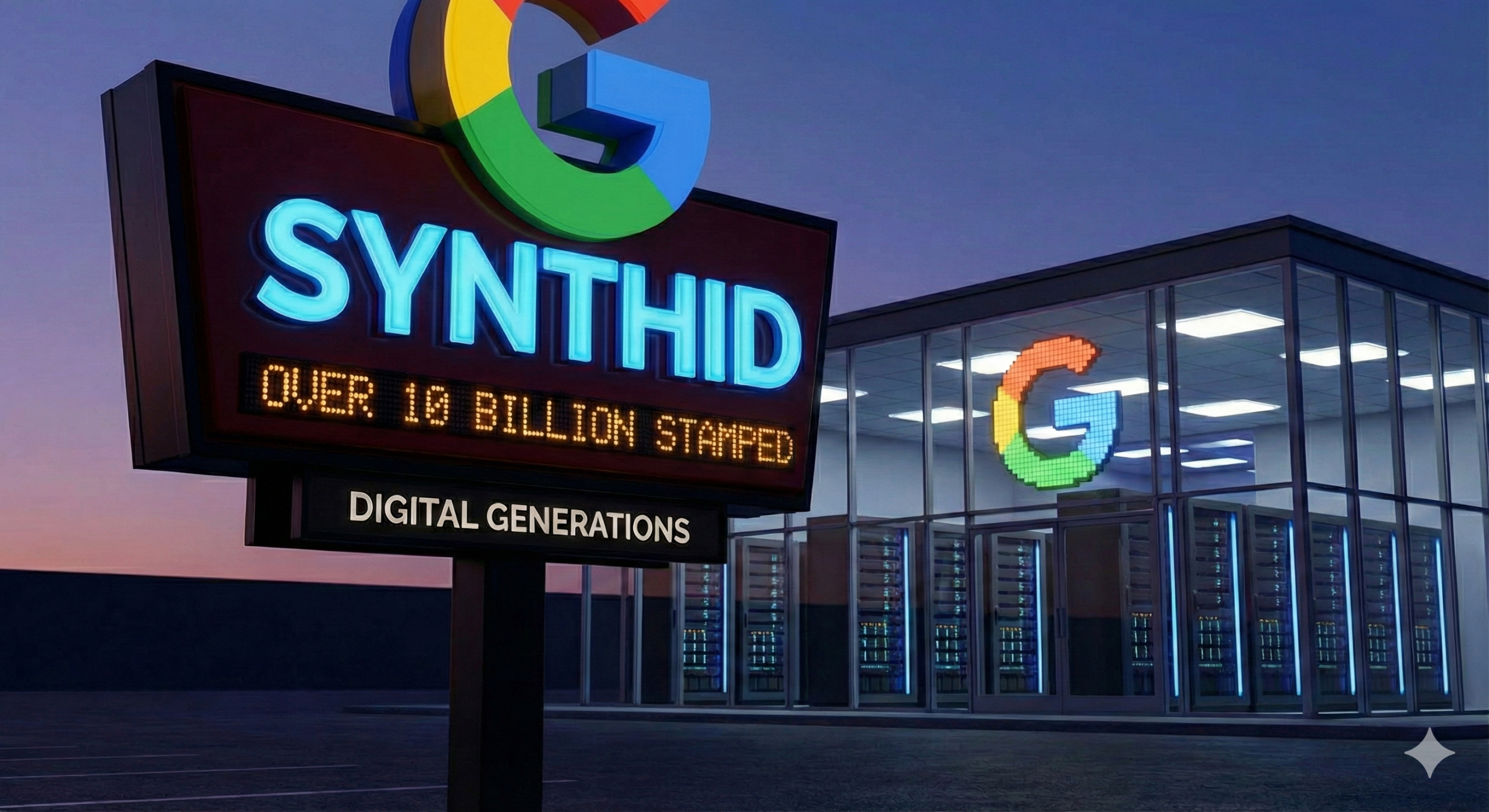
Here’s a publication by Google on SynthID-Image. This is the technology that Google has used to tag all generative images and video for some time now, including this beauty I prompted up this afternoon.

SynthID-Image works alongside C2PA, so the image above has, or should have, a C2PA manifest in addition to a SynthID watermark and an associated fingerprint. SynthID looks a bit like C2PA soft bindings from a distance. The watermark payload is large, though, at 136 bits, so that it can store provenance information directly, rather than a soft binding to some other resource, like C2PA. SynthID also has a fingerprint. In order to validate a SynthID file, you need to validate the watermark payload and then match the fingerprint. Neither alone is sufficient. That last step—requiring a fingerprint match—is beyond the scope of C2PA as far as I am aware.
You can read the full report here.
If you want a quick refresher on how C2PA should work with music, I got you covered in this video.
Landr survey—How Musicians Use AI
I recently encountered a survey that Landr did on AI use among musicians (webpage | pdf ). For me the most interesting take is that when you look at what people used AI for when they used it in the creative process, the top two use cases are lyrics and drums. That resonates with me greatly as a non-drummer who can sing but is not technically trained.
The second part is that there is a growing divide. Artists that are adopting AI are using it broadly and increasing adoption. But there is a segment of artists that are avoiding AI, and those folks are already way, way behind. This is really important, because once the copyright, training, and attribution issues are worked out, there will be unrestrained AI creation across the board. Everyone should be ready for that, and if you aren’t learning the tools now, you will be unprepared. This echoes what I heard at the conferences, as reported above.
Is SoStereo the first music library to accept gen AI music?
I heard a rumor about this online, and I reached out to them but have not heard back. The story is that SoStereo will accept music that is up to 20% gen AI. However, when I researched that, I did not find any official announcements of such, only secondhand sources via Reddit and Instagram, so it looks like this is not actually true.
But let’s pretend that it is, because it will likely happen soon anyway. It’s not clear how one is to prove their music is only 20% AI, but C2PA-style content provenance would be a great place to start! By tagging each ingredient in a track, one could establish a recipe that would make it pretty clear if you were over 20% from a track provenance perspective. But I’m not sure that’s how it would really work.
If you got together with another writer and co-wrote a song, you’d both get 50%. If there were five writers, they’d each get 20% unless otherwise agreed to. This is how I understand the “in the room” concept of writers’ splits. If you were there and contributed, you get an equal share. So I don’t think there are any guidelines for how to determine writer splits when AI is involved, but artists will need to make a strong case for why AI splits shouldn’t be treated like any other writer split.
All of which makes most AI-generated music ineligible for SoStereo anyways, if they were accepting partially AI-generated music, which they are probably not. Anyway, things are evolving, so let’s see what happens.
Takeaway Thought Exercise
How would you assign authoring credit to AI in a songwriting session?
And that’s a wrap for November. Happy Thanksgiving for those that observe it!
Leave a Reply