
Volume 2, Issue 3
Don’t Steal This Substack!
Maybe we are the only ones that didn’t realize that Ed Newton-Rex has a Substack entitled Don’t Steal This Blog. And if you didn’t know, you do know now, so go now and subscribe. Immediately after I did, I got his latest piece: LLMs Memorise Their Training Data. He discusses a Stanford paper that shows that with a little deceptive prompting and fine-tuning, large language models (LLMs) were quite happy to spit out large chunks of text straight from their training material. This has major implications for music—lyrics in particular—but music as well. So now you have some information to rebut the AI purists that insist that generative models don’t memorize their sources.
DDEX and C2PA?
For the uninitiated, Digital Data Exchange, or DDEX, is a public standards organization that is trying to bring sanity to music metadata. For those of my peeps in the sync music business who are constantly getting requirements for metadata in different formats and different places, DDEX is the solution to this madness, although it might be maddening to get there. In fact, I’m convinced that these libraries and publishers with extensive metadata requirements are just getting you to get the data in a format that they can use to ultimately participate in the DDEX ecosystem. So it is worth keeping an eye on and learning about DDEX. But how to DDEX and C2PA relate to each other?
DDEX and C2PA are both related, but separate, open standards. They can work in a complementary fashion even if they aren’t directly integrated. Mariusz Smenżyk over at MusicTechLab has just written a great article (including code and XML fragments for technical folks) about how the two standards together can solve some urgent issues we face, including relating music provenance to rights and ownership, which is critical. It’s called C2PA and DDEX: Authenticity Meets Rights in the Age of AI Music.
Gen AI Landrush
There is now a performing rights orgnaization (PRO) for AI music. Announced on March 28, 2026, AIMPRO is the first Performance Rights Organization (PRO) specifically for generative AI music, offering royalty registration and a licensing marketplace for AI creators. Membership is free, and they take a 15% cut, and of course, there is a monthly subscription that will change your life! Kidding. About the life-changing part. There is definitely a subscription. Also, there are some insiders behind this site, so if you are doing generative AI music and building a brand around AI musicians, it’s worth checking them out.
If you can’t ©, you ℗
And we also now have charts. Specifically, the Siqa AI charts. I spent a little time looking and listening to these songs and found a wide range of quality. All of the ones I searched for (no click-through on the charts) I found on YouTube. There is one trend I noticed that has not been widely reported. It is the use of the ‘℗’ symbol to represent owning the master sound recording. This appears to be an attempt by AI artists and producers to provide a legal basis for monetizing the song. It is a way of saying that regardless of copyright or the owners of the original composition, this entity owns the master recording. This is definitely an area to keep an eye on. I don’t think it’s going to work, because historically if there is no copyright, the song is in the public domain, but who knows these days?
A brief, imperfect history of 20th-century consumer device specialization
When the iPod was released in 2001, it set the state of the art for a specialized, fit-for-purpose device, as evidenced by its worldwide success.
In 2007, Apple released the iPhone. In reaction, many of the specialized tools, like the iPod, were reimagined and rewritten as apps. This caused a consolidation of devices to phone apps. People depended on their phone to be able to run anything.
The convergence of the pandemic with the emergence of useful AI technology is now breaking this trend and reversing it once again. Now, there is some pushback to the idea that everything can be created as an app. Point-and-shoot cameras are popular again. And Mariusz, whom I mentioned above, created BeatBuddy. I am really in awe of this device, because in an age where phones and watches dominate, this device proves that people need something more. They need specialized devices. In this case, a waterproof, sensor-laden training partner that works while swimming and provides haptic feedback. When I think back to my running days, I can see the appeal of this product immediately. More to the point, it illustrates this cycle of consolidation and de-consolidation playing out. In an age where you can prompt anything, custom hardware becomes important again. It’s boutique. It’s material, physical. And physical things are not AI.
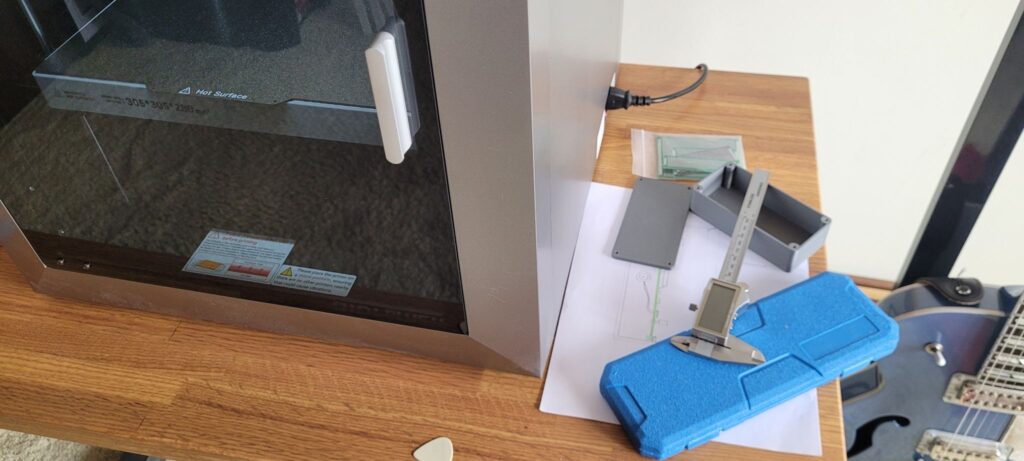
With that as prelude, I am happy to announce that we are doing some hardware development here at Catamount Music, along with some machine learning experiments. These efforts are all in service of guitarists, and, well, I can’t say a whole lot more than that.
However, I am building some prototypes I can talk about, including a level-boosting dual buffer that I happen to need for the lab. So be prepared to see more technical content as I get into the weeds building some devices. Fun fact: although I have spent my career in reliability and data center operations, I have a degree in electrical engineering, which helps a lot.
If you love playing guitar, machine learning, engineering, and AI and want to collaborate, please reach out. I have big plans and would love help doing things like building a dictionary of guitar terms, designing and fabricating a guitar breakout buddy for lab testing, finding ways to build amazing Faraday cages for analog audio circuits…those kinds of things.
Final Thoughts
We covered Suno more than enough last month. There has been plenty of additional news, but you are likely already hearing it. Instead, I give you TommyD, who updates his experience creating 50 songs in one evening. It’s no spoiler to say that he could not remember a single one the next day; it’s about the journey to that conclusion, which mirrors his feelings about creativity in general.
Also, a shoutout to Lars Murray at the Unlimited Supply Podcast, who broadcast his 500th episode in the last week of March. Congratulations!
Leave a Reply